
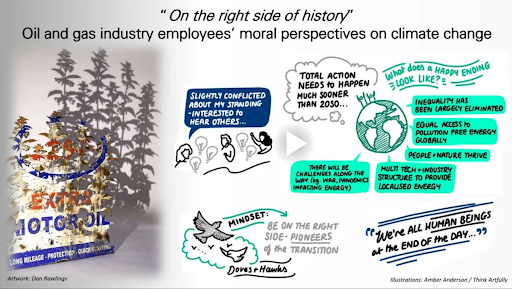
A new study uncovers how employees reconcile corporate environmental claims with their own moral aspirations amid growing societal pressure to move beyond fossil fuels.
Recent research by Fabien Littel, co-authored by Ai Yu and Professor Peter Rodgers shines a light on an often-overlooked dimension of the energy transition: the moral aspirations and lived experiences of the people working inside the oil and gas industry. Drawing on a Foucauldian lens, the article explores how employees navigate the growing tension between their companies’ corporate environmentalism and society’s increasing demand for a shift away from fossil fuels. Through interviews with industry workers and analysis of major oil companies’ public communications, the paper reveals how individuals actively negotiate their identities, ethics, and hopes for the future rather than simply absorb corporate narratives.
The study uncovers a rich and complex landscape of personal values and “aspirational modes of being,” showing how workers form themselves as ethical subjects in response to organisational, social, and relational pressures. These insights challenge common assumptions about industry insiders and open up new ways of understanding the potential for genuine environmental engagement from within the sector.
If you’re interested in how organisational power, personal ethics, and climate responsibility intersect inside one of the world’s most controversial industries, this article offers a fresh and compelling perspective.
The paper is now available in the October issue of Organisation Studies encouraging a view going beyond the amalgamation of industry insiders and their industry’s discourses, and the potential for individual engagement towards alternative futures.
Read the full piece here – Enacting Aspirational Modes of Being: Oil and gas employees’ subject formation and Telos under corporate environmentalism – Fabien Littel, Ai Yu, Peter Rodgers, 2025
Or see three minute summary here. 3-Minute Thesis entry – Oil and gas industry and climate change