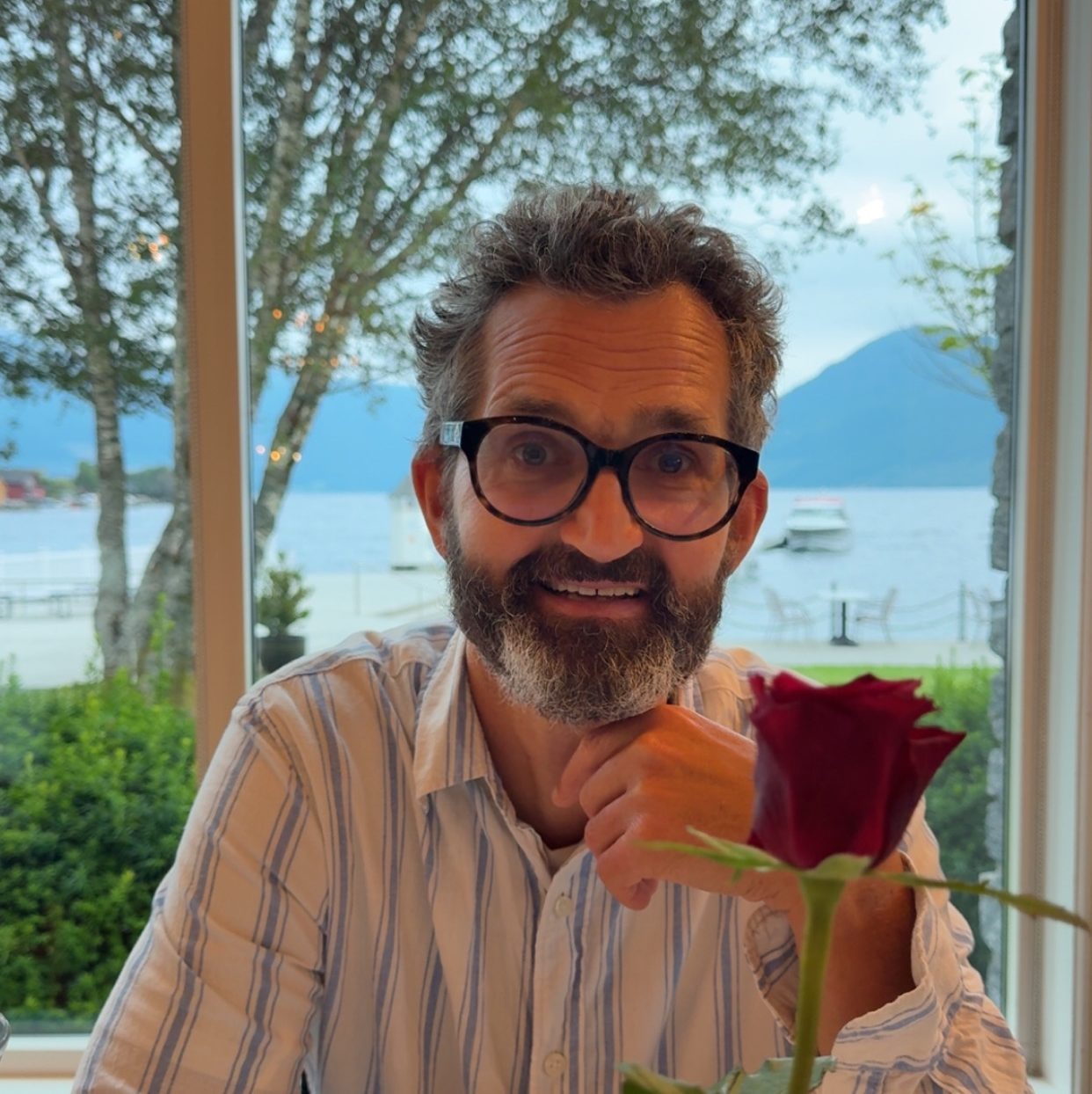
Daniel's Story
Working in the Fossil Fuel Industry
I hold an MSc in Geology from Royal Holloway, University of London, and began my career with Equinor in Stavanger in 2001 after leaving a PhD in structural geology.
For 23 years, I worked on building 3D geological and reservoir simulation models to predict oil and gas production. My work covered projects in Venezuela, Algeria, Iran, the UK, and especially the Norwegian North Sea.
Over time, I became deeply involved in the transition toward ensemble-based reservoir modelling, where hundreds of models are generated to quantify uncertainty in what we cannot directly observe underground. I became one of the company’s leading specialists in this field. One project I remain particularly proud of is the reservoir model for the giant Snorre field, which is still in use today more than a decade later.
In my final years at Equinor, I worked as a quality advisor on modelling for the Northern Lights carbon capture project.
I genuinely loved the intellectual side of the work. The combination of geology, programming, statistics, and uncertainty analysis was deeply rewarding, and I worked alongside highly skilled and supportive colleagues in what I considered to be a very humane working environment.
At the same time, my growing awareness of the long-term consequences of fossil fuel production gradually became harder to ignore.
When I realised it was time to leave
The turning point was not sudden. It developed gradually through my work with uncertainty and decision-making.
Professionally, I spent years analysing uncertainty underground. Personally, that led me to think more deeply about cognitive bias and the stories we tell ourselves to justify difficult realities. I started asking myself what simplified answers I was using to explain my own role in the industry.
A series of books profoundly shifted my worldview, including Thinking, Fast and Slow by Daniel Kahneman, Silent Spring by Rachel Carson, and Prosperity Without Growth by Tim Jackson.
When my employer refused to let me take a university course on planetary boundaries during work hours, arguing that internal sustainability training was sufficient, I completed it in my own time. The contrast between independent climate science and the company narrative deeply unsettled me.
By 2021, following another major IPCC climate report, I felt unable to stay silent. I began speaking up internally about my concerns. For a brief period, there seemed to be momentum for change, but after the pandemic the focus shifted heavily toward energy security, and I increasingly felt that the industry was moving backwards rather than forwards.
In August 2024, I joined Greta Thunberg and Extinction Rebellion in blocking the Kårstø gas terminal in Norway. Shortly afterwards, I reached an agreement to leave Equinor.
What I'm doing today
Today, I study pedagogy at the University of Stavanger while working as a substitute science teacher.
Initially, I expected to transition into renewable energy or another technical field. After years working with advanced digital tools, data analysis, and software development inside Equinor, I assumed finding a new role would be straightforward. When it was not, it was a significant blow to my ego.
In hindsight, I now see that experience differently.
My technical background strengthened my analytical thinking enormously, but I also realised that technical competence alone is not enough if it is disconnected from wider ethical questions. I still believe deeply in scientific reasoning, but I no longer believe that optimisation and efficiency alone can solve the problems we face.
Today, I want to contribute in a different way: by helping younger generations build both scientific understanding and ethical awareness. I want students to think critically about extraction, consumption, and the systems that shape society, while also understanding the urgency of climate and ecological challenges.
For me, teaching feels far more aligned with the kind of contribution I now want to make.
Parting Reflections
One thing that strikes me in retrospect is how rarely these concerns were openly discussed inside the industry.
Whenever I raised these issues publicly or internally, I would receive private messages from colleagues thanking me for speaking up. Many people were clearly concerned, yet these conversations rarely happened openly in everyday working life. There was an unspoken silence around the subject.
I also want to be very clear that I do not blame ordinary employees who remain in the industry. People want stability, security, and a good life for their families. That is entirely understandable.
My criticism is directed more toward political leadership and corporate leadership that publicly acknowledge the need for change while continuing to delay meaningful action.
For those who privately doubt the direction the industry is taking, my message is simple: either speak up or leave if that feels like the honest path for you. I chose to leave.
It has not been easy. I still have not fully landed in a permanent role, and I may never earn what I once did. But despite the uncertainty, I feel better than I have in years because I no longer live with the same cognitive dissonance.
For me, that has been worth it.